Zimbabwe Political Context: February 2019
Introduction: The 2019 Protests
[The full pdf report can be downloaded here.]
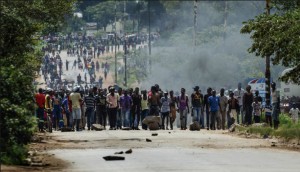
Protestors, Harare, 14 January 2019 (Newsday)
Since the November 2017 military coup, Zimbabwean politics was once again plunged into a legitimacy crisis, a situation exacerbated by the contestations over the July 2018 Harmonised election results, and the violence that followed on 1 August. Notwithstanding the political and economic reformist language of international re-engagement of the Mnanagagwa regime since that moment, the shadow of Mugabe’s authoritarian nationalist politics continued to hover over the post- coup attempt at political renewal. With the economic crisis deepening throughout 2018, the already fragile livelihoods of the majority of Zimbabwean citizens became even more precarious. In late 2018, public sector workers including doctors, nurses and teachers went on strike over their depreciated salaries and working conditions in the face of rising inflation and the persistent monetary crisis in the country. Representing around 27.4 % of formal employment, the largest portion of formal employment in the country, the striking public sector workers presented a serious problem for the functioning of the state. Looking back to the 1990’s it was the public sector strike of 1996 that signalled the onset of the broader trade union challenge to the Government’s neo-liberal policies at a time when formal sector employment, though already on the decline, had a broader base.1 The public sector strikes of late 2018 with the attendant fiscal challenges, once again presented a serious challenge to the professed attempts at fiscal restraint by the ED regime.
However, it was the steep increase of the price of fuel in January 2019 that provided the spark for a new round of popular protests. On the eve of his trip to Russia, Azerbaijan, Belarus and Kazakhstan, Mnangagwa announce a 250% rise in the price of fuel. In response the President of the ZCTU Peter Mutasa and the leader of the #ThisFlag movement Evan Mawarire called for a peaceful stay-away by the workforce from 14-16 January as a protest against this latest round of economic policy interventions. (Read more…)
Wed, February 20 2019 » Human rights, Reports, Zimbabwe Review » Leave a comment
Introduction
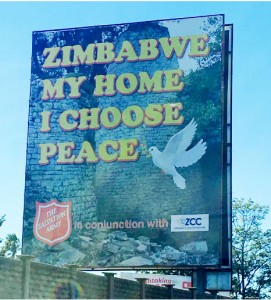 After the coup in November 2017, a central part of the coup leader’s strategy was to move beyond the shadow of the coup through an election process that was seen to be peaceful and credible. As the Presidential spokesperson explained it, for ED Mnangagwa and his team July 30 ‘was not about winning votes qua votes, but about securing re-‐engagement and the myriad benefits flowing therefrom’.1 Thus this ‘open for business’ mantra was accompanied by selective electoral reforms. These included: The introduction of the BVR voting system; the ensuring of a more peaceful and tolerant electoral environment; and an invitation to a wide range of international observers including the EU, US, SADC, AU, and the Commonwealth to monitor and report on the election. As part of the narrative of international re-‐engagement, national unity and reconciliation that marked his discourse since the coup, Mnangagwa also conducted a series of meetings with minority communities. In June, Chiwenga met with the Asian business community, and In July the Zanu PF President met with the representatives of the white community and invoked the language of reconciliation that Mugabe deployed in the immediate post 1980 period: We should cease to talk about who owns farms in terms of colour.
We should cease talking about that. A farmer-‐black farmer, a white farmer-‐is a Zimbabwean farmer. We should begin to develop a culture among our people to accept that we are one.2
The opposition, led by the largest party the MDC Alliance and its young leader Nelson Chamisa, made it clear from early on in its election campaign that there were serious problems in the election process that had not been dealt with. The problem areas included the partisan status of the Zimbabwe Election Commission, the late release of the voter’s role, lack of transparency around the printing of the ballot papers, and the lack of equal access to the public media. Moreover Chamisa stated throughout his campaign that his party would not accept any result other than his Presidential victory. In addition to these challenges the opposition was also caught up in the outcome of a bitter succession battle after the death of Morgan Tsvangirai which resulted in yet another split in the MDC. Chamisa’s victory over Thoko Khupe in a political battle marred by violence, misogyny and, at the very least, a questionable constitutionality, once again marred the image of the opposition.
Notwithstanding the differences between the two major parties their election manifestos converged around the need for macro-‐economic stabilisation and market-‐based reforms. Both were competing for international financial approval and investment promises.
The full pdf report can be downloaded here.
(Read more…)
Mon, October 1 2018 » 2018, Election violence, Elections, Reports, Uncategorized » Leave a comment
Political Context: 2017-‐2018
Introduction: The Trigger of Factional Politics
November 2017 witnessed tumultuous events in Zimbabwean politics. After months of factional struggles between the Lacoste faction led by then Vice President Emmerson Mnangagwa, also nicknamed the crocodile, and the Generation 40 (G40) faction around President Robert Mugabe and his wife Grace, Mugabe fired Mnangagwa on the 6th November. This followed Mugabe’s warning to Mnangagwa two days before when Grace Mugabe was booed at a rally in Bulawayo. The President’s wife threatened the embattled Vice President with the call that the ‘snake must be hit on the head.’ This was the First Lady’s decisive move in her bid for the Vice Presidency in the upcoming Zanu PF congress in December 2017.
This most recent factional struggle in Zanu PF follows a long history of violent internal battles within the party, from the years of the liberation struggle in the 1970s around ethnic and ideological questions. A few years prior to his own party exile, Mnangagwa played a central role in the removal of the previous Vice President Joice Mujuru, the wife of a key liberation commander Solomon Mujuru. As Miles Tendi has demonstrated, Mnangagwa, in support of the Mugabe’s, with the central involvement of Army Chief Constantine Chiwenga and the machinery of the military intelligence, conspired in the ousting of Joice Mujuru. This event took place after a long factional struggle between the Mujuru and Mnangagwa factions since the 1990s.1 Thus both the Mugabe’s succession plan and Mnangagwa’s long held Presidential ambitions have been in play for some time. While they have at certain times coincided in their strategic intent, at some point the final confrontation between the two was always on the cards.
The firing of Mnangagwa from the Vice Presidency and his expulsion from Zanu PF, however, had vastly different effects on the Zimbabwean polity. While Joice Mujuru’s dismissal and the expulsion of several of her allies caused some disturbance in the ruling party, it was nothing like the turbulence that followed Mnangagwa’s removal, and the attempt to arrest General Chiwenga at the airport on his return from China. The statement justifying the decision to fire Mnangagwa, accused the former Vice President of persistently exhibiting ‘disloyalty, disrespect, deceitfulness and unreliability’, and that he had behaved in a manner ‘inconsistent with his official duties’.2
In response Mnangagwa, who fled the country soon after his removal from Government, accused Mugabe of allowing the ruling party to be ‘hijacked by novices and external forces’ with a track record of ‘treachery’. In a manner that gave a clear indication of the intervention that would follow Mnangagwa warned Mugabe:
I will go nowhere. I will fight tooth and nail against those making a mockery against Zanu PF founding principles. You and your cohorts will instead leave Zanu PF by the will of the people and this we will do in the coming weeks.3
1 M.B. Tendi, State Intelligence and the Politics of Zimbabwe’s Presidential Succession. African Affairs, 2016. DOI: 10.1093/afraf/adis 074.
2 Press Statement: Termination of Employment of Vice President Emmerson Mnangagwa. S.K. Moyo, Minister of Information, Media and Broadcasting Services, 6 November 2017.
3 Press Statement-‐Former Hon VP ED. Mnangagwa 8 November 2017.
Fri, February 23 2018 » Reports » Leave a comment
Shari Eppel, Director, Solidarity Peace Trust

Harare – the morning after (stevenchikosi.com)
As I gaze into the tea leaves at the bottom of my first post-Mugabe cup of tea, I try to divine the future of our nation, Zimbabwe. Last night was sheer euphoria here on the streets of Bulawayo, and of course throughout the nation, as spontaneous crowds gathered to dance and cheer the dictator on his way. His resignation that we had all been expecting hourly for the previous week, had finally come late in the afternoon of 21 November, after impeachment proceedings had already begun in Parliament. Now, it is a bitter-sweet ‘morning after’, sipping the dregs of my Five Roses tea. It has always been not just about Mugabe going, but what happens once he is gone. And what a crazy fortnight it has been, not just for Zimbabwe, but in terms of recent African history. (Read more…)
Wed, November 22 2017 » History » Leave a comment
Brian Raftopoulos, Director of Research and Advocacy, Solidarity Peace Trust.
The last two weeks have witnessed tumultuous events in Zimbabwean politics. After months of factional struggles between the Lacoste faction led by then Vice President Emerson Mnangagwa, also nicknamed the crocodile, and the Generation 40 (G40) faction around President Robert Mugabe and his wife Grace, also known as Gucci Grace, Mugabe fired Mnangagwa on the 6th November. This followed Mugabe’s warning to Mnangagwa two days before when Grace Mugabe was booed at a rally in Bulawayo. The President’s wife threatened the embattled Vice President with the call that the ‘snake must be hit on the head.’ This was the First Lady’s decisive move in her bid for the Vice Presidency in the upcoming Zanu PF congress in December 2017. (Read more…)
Tue, November 21 2017 » Zimbabwe Review » Leave a comment