Tinashe Nyamunda analyses the Reserve Bank of Zimbabwe’s efforts to address the liquidity shortage in the country.

Zimbabwe $2 Bond Note
Zimbabwe’s export incentive scheme was introduced to encourage exports and address the liquidity crunch in the country. If, for example, tobacco exporters accept bond notes, they receive a five percent incentive in addition to their export earnings. But in a country with a serious shortage and rationing of foreign exchange, accepting bond notes whose value against the US dollar is uncertain in the immediate-to-long term is not really a choice. Barely a month after the initial introduction of the infamous bond notes under the so-called “export incentive scheme,” the Reserve Bank of Zimbabwe (RBZ) has disbursed more bond notes currency into Zimbabwe’s financial system. On 28 November 2016, the RBZ introduced $10 million, followed by a further $7 million and $12 million barely a month later, bringing the full amount in circulation to $29 million. Fully aware of predictions that the introduction of bond notes would result in hyperinflation, the RBZ has resorted to disbursing the pseudo currency on a “drip feed” basis. Contrary to earlier popular belief that bond notes would immediately trigger hyperinflation, their slow introduction has not even resolved the cash shortages. But does this translate to a proper management of currency emanating from fears of hyperinflation? What follows is my opinion on what bond notes have meant for the Zimbabwean economy in the first month of their introduction and their possible long term legacy. (Read more…)
Sun, January 1 2017 » Economy, Zimbabwe Update » Leave a comment
by Musiwaro Ndakaripa
(International Studies Group, University of the Free State, South Africa)
5 December 2016.
Introduction
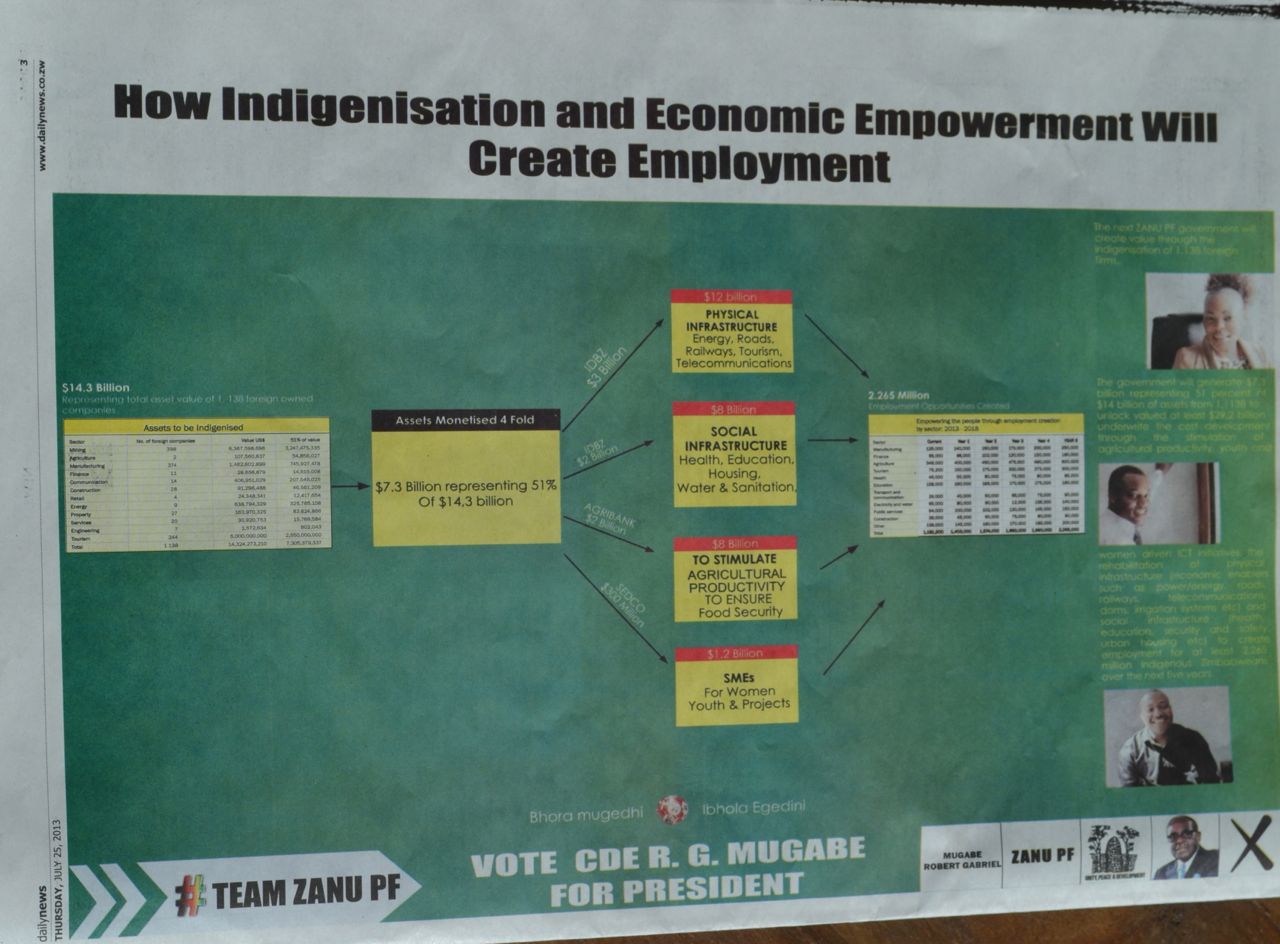
Economic indigenisation has been a recurring theme in post-colonial Zimbabwe.[1] In the early 2000s the Zimbabwe African National Union – Patriotic Front (ZANU-PF) government tended to conflate indigenisation with the land question for electoral purposes. However, as the land question lost its lustre in the late 2000s indigenisation stood as a distinct subject shaping the political landscape in the country. A critical examination of recent developments on the indigenisation policy suggest that ZANU-PF piggybacked the Movement for Democratic Change (MDC) parties during the power sharing government (PG) era by enforcing the Indigenisation and Economic Empowerment Act of 2007[2] despite its negative effects on foreign investment and the economy in general. ZANU-PF’s game plan was to gain popularity through the policy but share the blame with other political parties in the government if the economy was to nosedive. Once ZANU-PF retained power and faced the unenviable task of sustaining and growing the economy the party climbed down on indigenisation. This is apparent in public pronouncements by senior government officials and the lukewarm implementation of the policy. (Read more…)
Mon, December 5 2016 » Economy, Zimbabwe Review » Leave a comment
Tinashe Nyamunda looks at Zimbabwe’s ‘liquidity crunch’
A political storm is brewing in Zimbabwe over the introduction of some US$75 million worth of bond notes, initially scheduled for the end of October but which the Reserve Bank of Zimbabwe (RBZ) has delayed to November – or even December (as it is unsure of public response).
This is sparking protests from different political movements in Zimbabwe – such as the Evan Mawarire-led #thisflag and Prosper Mkwananzi’s #tajamuka – and government faces legal challenges from former Vice-President and leader of the newly-formed Zimbabwe People First (ZPF) Joice Mujuru, prominent Harare businessmen Fredrick Mutanda, and lawyer Fadzai Mahere. Many see the notes as unbacked bond paper with currency denominations printed on them. They believe their value will rapidly collapse.
This is despite the US$200 million dollar facility that the RBZ claims to have accessed from the African Export Import (Afrexim) Bank to back the new bond notes and hold their value.
But, as economist John Robertson has argued, ‘money is all about trust’. The people of Zimbabwe do not trust the bond notes because of the horrors of Zimbabwe’s recent hyperinflation past. For that reason, their introduction is seen as the act of a desperate and predatory government seeking to return to worthless Zimbabwe dollars. Many believe that this will only result in ordinary people suffering, while providing new avenues of accumulation for the political elite. (Read more…)
Wed, November 23 2016 » Economy, Zimbabwe Review » Leave a comment
By Brian Raftopoulos
Since the end of the Global Political Agreement (GPA) in 2013, a SADC facilitated settlement that sought to move Zimbabwe out of the legitimacy crisis of the widely discredited elections of 2008, Mugabe’s Zanu PF has been battling to find ways to re-engage Western Governments and the international financial institutions based on limited economic and political reforms. After some early indications in the post-GPA period that the Government of Zimbabwe was keen to cooperate on reform measures set by the international financial institutions, Zanu PF has persistently displayed its determination to avoid any serious reforms.
Apart from a more pragmatic if still unclear enunciation of the indigenisation programme, based on the 2007 Act which established the requirement of 51% ownership by ‘indigenous Zimbabweans’ of all foreign owned companies, and small changes to improve the business environment and facilitate business dealings, there remains a major reluctance to engage in more substantive reforms demanded by donors and the MDC formations. (Read more…)
Sun, November 13 2016 » Global Political Agreement, Human rights, Zimbabwe Review » Leave a comment
Brian Raftopoulos, Director of Research Solidarity Peace Trust.
Introduction
Since the 2013 elections the convulsions within the ruling party have intensified to unprecedented levels. In response to this phenomenon there has been a good deal of analytical commentary on these struggles, focusing on the nature and causes of the contestations and centring mainly on the central question of Presidential succession. 1 Common to all the analyses is the challenge of stabilising and democratising the Zimbabwean state by dealing both with the legacies of colonial period and their continuities, as well as their new iterations, in the post-colonial era. This is not a problem peculiar to Zimbabwe, and in different forms continues to haunt the state in post-colonial Africa, as it is forced to contend with the legacies of both structural inequalities and despotic forms of rule. 2
In Zimbabwe this problem has manifested itself in a centralised, authoritarian ruling party that has conflated its operations with that of the state and overseen the erosion of the capacity of state structures to deliver to and protect the broader citizenry. In the rural areas the state has entrenched its power bases through a combination of coercion, a failure to democratise ‘traditional’ structures and the increasing placement of these under state/party control. Importantly, this consolidation of control in the countryside has also been the result of the delivery of land, with all its attendant problems, through the fast track land reform process. In the urban areas Zanu PF’s control over peri-urban land politics is linked to its undermining of the opposition’s tenuous control of certain urban local government structures and has furthered the reach of Zanu PF’s structures of power and patronage. 3 (Read more…)
Thu, June 9 2016 » Zimbabwe Update » 1 Comment