By Ukuthula Trust & Solidarity Peace Trust
Bulawayo, 6th October 2015
There is desperation. It’s hope without hope. You appear to have a job when in real terms you don’t have a job. You get up and dress every day and go to town and see people passing your stand, hoping maybe you will sell something.
This report is the fifth in a series by the same authors, tracking the impact of Operation Murambatsvina (OM) on the lives and livelihoods of Zimbabweans, in particular in Matabeleland. Once more, we have in many cases managed to relocate specific families and have updated how they have coped, or not coped, with life over the last ten years. We believe this longitudinal research is important as it conveys the lasting impact of gross human rights violations such as those epitomized by OM, as well as providing insight into the current functioning of the informal sector and housing challenges.
The introductory section places the report in the broader socio-economic context. Tracing the damage done by OM over the last decade remains topical at a point where the government of Zimbabwe and the steadily increasing urban vending community are once more at loggerheads. Throughout 2015, there have been running battles between vendors in Harare and the police, and ultimatums issued for vendors to decentralise from Harare’s streets. Yet, the broader economic context is that out of 6,300,000 people in employment in Zimbabwe, approx. 5,900,000 are employed informally. Clearly, once more hounding vendors off the streets is not a solution to the nation’s prevailing economic catastrophe when alternative employment does not exist.
Rights reserved: Please credit the Solidarity Peace Trust as the original source for this material republished on other websites. Please provide a link back to http://www.solidaritypeacetrust.org/download/report-files/Hope%20without%20hope%206%20october%202015.pdf for this report
This article can be cited in other publications as follows: Ukuthula Trust & Solidarity Peace Trust (2015) Hoping without Hope: Murambatsvina – Ten Years On. Durban: Solidarity Peace Trust
Thu, October 8 2015 » Operation Murambatsvina, Reports » Leave a comment
James Muzondidya. Zimbabwean Researcher and Analyst.
One of the dominant and recurring themes in civil society discourses around the revival and strengthening of the Zimbabwean civic movement is the issue of social movements. At almost every Civil Society Organization (CSO) workshop/meeting that has been convened since July 2013, there has been a general consensus amongst CSO leaders, policy and strategy advisors and research practitioners that there is a critical need for the civic movement to reconnect with its social base in order to remain relevant, legitimate and powerful. Much more importantly, it has been strongly argued that there is an imperative need for a sustained process of (re)building social movements that can push for the realization of Zimbabwean citizens’ socio-economic rights and interests as well as social and political change. What has, however, been critically missing in this emerging ‘post-July 31 consensus’ is some serious thinking about how this social movement (re)building process is supposed to be done; the kind of social movements envisioned; the opportunities and challenges involved in rebuilding these social movements; the role that contemporary CSOs is supposed to play in the whole process; and the strategies required for such a process to succeed. This discussion paper seeks to examine the key issues that need to be considered in Zimbabwean civil society’s deliberations around social movement rebuilding. (Read more…)
Tue, June 2 2015 » Zimbabwe Review » Leave a comment
PRESS STATEMENT
The Solidarity Peace Trust is deeply shocked and saddened by the recent wave of racist and xenophobic violence that has taken place in several South African cities particularly in Kwazulu Natal and Gauteng.
As a human rights organisation working for peace and justice in Southern Africa, we add our voice to those of Civil Society, Government, Trade Unions as well as the peace loving South Africans in condemning these xenophobic attacks.
We acknowledge that there are a number of social and economic challenges facing South Africa’s poorer communities. However there can be no justification whatsoever for these acts of violence.
We are overwhelmed by the generosity of ordinary community members from Phoenix and Chatsworth near Durban as well as other cities across the country who responded so quickly to the call by ourselves and other NGOs for support and assistance to the displaced, injured and affected people.
We thank the government of the Republic of South Africa, and the various African embassies for their support in assisting the displaced people who chose to return home. However our experience over the years tells us that the vast majority of foreign nationals will remain in South Africa and this will require that the government of South Africa strengthen its efforts in dealing more decisively with the structural causes of the xenophobic violence.
Finally we call on all religious organisations to dedicate this Sunday 26 April 2015 to a Prayer for Peace in Africa as we note the spread of this hatred and anger to other parts of the continent.
ISSUED BY: Josephat Tshuma. (CHAIRPERSON)
SOLIDARITY PEACE TRUST
38 MITCHEL DRIVE
PORT SHEPSTONE
ENQUIRIES:
SELVAN CHETTY 0396825869 | 0835561726 | Email: selvanc@venturenet.co.za
Sat, April 25 2015 » Press Releases » Leave a comment
Brian Raftopoulos, Director of Research and Advocacy, Solidarity Peace Trust.
Introduction
In an insightful commentary on the current state of Zimbabwe politics, Joost Fontein writes about the prevalence of despondency in which a ‘new timescale of hope and aspiration’ has emerged ‘that makes both the present and any immediate future appear equally uninspiring.’1 In many ways this resignation to the politics of the long haul reflects the loss of hope in an imminent alternative, which was the structure of feeling that fuelled the social imagination of opposition and civic politics from the late 1990’s until the complexities and complicities of the Global Political Agreement. Underlying this politics of despair are a plethora of factors, ranging from the re-organisation of Zanu PF and its political machinery of patronage, coercion and electoral chicanery, to the massive dissipation of opposition energies in the context of large-scale changes in Zimbabwe social structure since the 1990’s. The recent implosion in Zanu PF around the politics of succession have, moreover, provided further evidence of the pervasive mood of despair in Zimbabwe’s polity, even against the background of the ruling party’s purported victory and resurgence in the 2013 election. (Read more…)
Tue, March 24 2015 » Zimbabwe Review » Leave a comment
Introduction
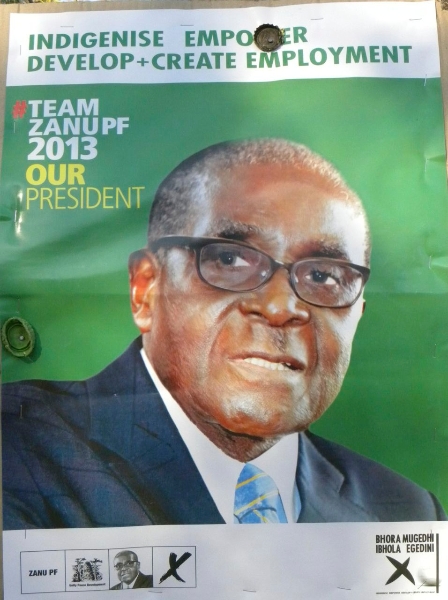
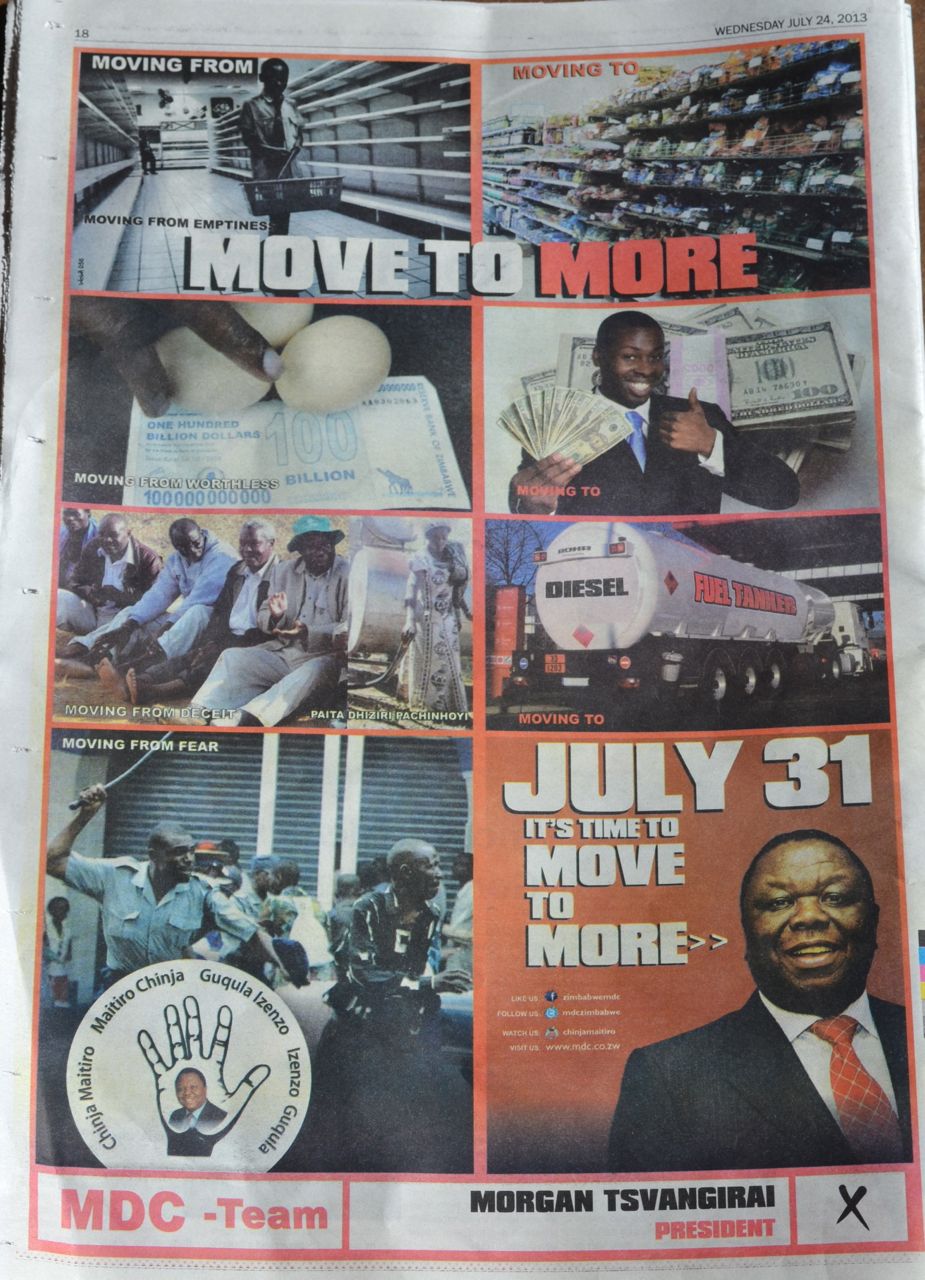
Zanu PF’s and Mugabe’s overwhelming electoral ‘victory’ in July 2013 was the result of a combination of the continuing legacy of firmly inscribed memories of post-colonial violence, Zanu PF’s persistent legitimacy from the liberation struggle, the declining fortunes of the opposition MDCs, the combination of coercion and patronage by the ruling party in context of a reconstructed political economy, regional solidarity for the ‘party of liberation, and the limits of international pressure on the Zimbabwean crisis.1
In the aftermath of this ‘victory’ Zanu PF has had to confront the challenges of presiding over a radically transformed political economy which, while it contributed to electoral success, now poses huge problems for economic progress. While the combination of a radical land programme, deindustrialisation and a rapidly informalised urban sector, and a strong reliance on the mineral sector, reconfigured the social basis of the electorate in Zanu PF’s favour, it also presents major challenges for economic growth in the post-election period. The central economic challenges confronting Zanu PF include: an external debt amounting to US$6 billion; liquidity constraints resulting in deflationary demand trends; limited inflow of foreign direct investment; lack of industrial competitiveness which is also affected by low domestic demand; loss of confidence in an increasingly vulnerable financial sector; lack of transparency and accountability in the key mineral sector; and a widening current account deficit due to the faster growth of imports.2 (Read more…)
Fri, June 27 2014 » 2013, Elections » 1 Comment