Zimbabwe Political Context: February 2019
Introduction: The 2019 Protests
[The full pdf report can be downloaded here.]
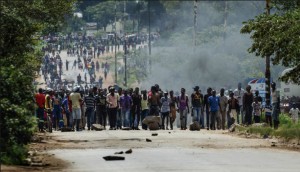
Protestors, Harare, 14 January 2019 (Newsday)
Since the November 2017 military coup, Zimbabwean politics was once again plunged into a legitimacy crisis, a situation exacerbated by the contestations over the July 2018 Harmonised election results, and the violence that followed on 1 August. Notwithstanding the political and economic reformist language of international re-engagement of the Mnanagagwa regime since that moment, the shadow of Mugabe’s authoritarian nationalist politics continued to hover over the post- coup attempt at political renewal. With the economic crisis deepening throughout 2018, the already fragile livelihoods of the majority of Zimbabwean citizens became even more precarious. In late 2018, public sector workers including doctors, nurses and teachers went on strike over their depreciated salaries and working conditions in the face of rising inflation and the persistent monetary crisis in the country. Representing around 27.4 % of formal employment, the largest portion of formal employment in the country, the striking public sector workers presented a serious problem for the functioning of the state. Looking back to the 1990’s it was the public sector strike of 1996 that signalled the onset of the broader trade union challenge to the Government’s neo-liberal policies at a time when formal sector employment, though already on the decline, had a broader base.1 The public sector strikes of late 2018 with the attendant fiscal challenges, once again presented a serious challenge to the professed attempts at fiscal restraint by the ED regime.
However, it was the steep increase of the price of fuel in January 2019 that provided the spark for a new round of popular protests. On the eve of his trip to Russia, Azerbaijan, Belarus and Kazakhstan, Mnangagwa announce a 250% rise in the price of fuel. In response the President of the ZCTU Peter Mutasa and the leader of the #ThisFlag movement Evan Mawarire...Read more
Wed, February 20 2019 » Human rights, Reports, Zimbabwe Review » Leave a comment
Brian Raftopoulos, Director of Research and Advocacy, Solidarity Peace Trust.
The last two weeks have witnessed tumultuous events in Zimbabwean politics. After months of factional struggles between the Lacoste faction led by then Vice President Emerson Mnangagwa, also nicknamed the crocodile, and the Generation 40 (G40) faction around President Robert Mugabe and his wife Grace, also known as Gucci Grace, Mugabe fired Mnangagwa on the 6th November. This followed Mugabe’s warning to Mnangagwa two days before when Grace Mugabe was booed at a rally in Bulawayo. The President’s wife threatened the embattled Vice President with the call that the ‘snake must be hit on the head.’ This was the First Lady’s decisive move in her bid for the Vice Presidency in the upcoming Zanu PF congress in December 2017. Read more
Tue, November 21 2017 » Zimbabwe Review » Leave a comment
by Musiwaro Ndakaripa
(International Studies Group, University of the Free State, South Africa)
5 December 2016.
Introduction
Economic indigenisation has been a recurring theme in post-colonial Zimbabwe.[1] In the early 2000s the Zimbabwe African National Union – Patriotic Front (ZANU-PF) government tended to conflate indigenisation with the land question for electoral purposes. However, as the land question lost its lustre in the late 2000s indigenisation stood as a distinct subject shaping the political landscape in the country. A critical examination of recent developments on the indigenisation policy suggest that ZANU-PF piggybacked the Movement for Democratic Change (MDC) parties during the power sharing government (PG) era by enforcing the Indigenisation and Economic Empowerment Act of 2007[2] despite its negative effects on foreign investment and the economy in general. ZANU-PF’s game plan was to gain popularity through the policy but share the blame with other political parties in the government if the economy was to nosedive. Once ZANU-PF retained power and faced the unenviable task of sustaining and growing the economy the party climbed down on indigenisation. This is apparent in public pronouncements by senior government officials and the lukewarm implementation of the policy. Read more
Mon, December 5 2016 » Economy, Zimbabwe Review » Leave a comment
Tinashe Nyamunda looks at Zimbabwe’s ‘liquidity crunch’
A political storm is brewing in Zimbabwe over the introduction of some US$75 million worth of bond notes, initially scheduled for the end of October but which the Reserve Bank of Zimbabwe (RBZ) has delayed to November – or even December (as it is unsure of public response).
This is sparking protests from different political movements in Zimbabwe – such as the Evan Mawarire-led #thisflag and Prosper Mkwananzi’s #tajamuka – and government faces legal challenges from former Vice-President and leader of the newly-formed Zimbabwe People First (ZPF) Joice Mujuru, prominent Harare businessmen Fredrick Mutanda, and lawyer Fadzai Mahere. Many see the notes as unbacked bond paper with currency denominations printed on them. They believe their value will rapidly collapse.
This is despite the US$200 million dollar facility that the RBZ claims to have accessed from the African Export Import (Afrexim) Bank to back the new bond notes and hold their value.
But, as economist John Robertson has argued, ‘money is all about trust’. The people of Zimbabwe do not trust the bond notes because of the horrors of Zimbabwe’s recent hyperinflation past. For that reason, their introduction is seen as the act of a desperate and predatory government seeking to return to worthless Zimbabwe dollars. Many believe that this will only result in ordinary people suffering, while providing new avenues of accumulation for the political elite. Read more
Wed, November 23 2016 » Economy, Zimbabwe Review » Leave a comment
By Brian Raftopoulos
Since the end of the Global Political Agreement (GPA) in 2013, a SADC facilitated settlement that sought to move Zimbabwe out of the legitimacy crisis of the widely discredited elections of 2008, Mugabe’s Zanu PF has been battling to find ways to re-engage Western Governments and the international financial institutions based on limited economic and political reforms. After some early indications in the post-GPA period that the Government of Zimbabwe was keen to cooperate on reform measures set by the international financial institutions, Zanu PF has persistently displayed its determination to avoid any serious reforms.
Apart from a more pragmatic if still unclear enunciation of the indigenisation programme, based on the 2007 Act which established the requirement of 51% ownership by ‘indigenous Zimbabweans’ of all foreign owned companies, and small changes to improve the business environment and facilitate business dealings, there remains a major reluctance to engage in more substantive reforms demanded by donors and the MDC formations. Read more
Sun, November 13 2016 » Global Political Agreement, Human rights, Zimbabwe Review » Leave a comment
James Muzondidya. Zimbabwean Researcher and Analyst.
One of the dominant and recurring themes in civil society discourses around the revival and strengthening of the Zimbabwean civic movement is the issue of social movements. At almost every Civil Society Organization (CSO) workshop/meeting that has been convened since July 2013, there has been a general consensus amongst CSO leaders, policy and strategy advisors and research practitioners that there is a critical need for the civic movement to reconnect with its social base in order to remain relevant, legitimate and powerful. Much more importantly, it has been strongly argued that there is an imperative need for a sustained process of (re)building social movements that can push for the realization of Zimbabwean citizens’ socio-economic rights and interests as well as social and political change. What has, however, been critically missing in this emerging ‘post-July 31 consensus’ is some serious thinking about how this social movement (re)building process is supposed to be done; the kind of social movements envisioned; the opportunities and challenges involved in rebuilding these social movements; the role that contemporary CSOs is supposed to play in the whole process; and the strategies required for such a process to succeed. This discussion paper seeks to examine the key issues that need to be considered in Zimbabwean civil society’s deliberations around social movement rebuilding. Read more
Tue, June 2 2015 » Zimbabwe Review » Leave a comment
Brian Raftopoulos, Director of Research and Advocacy, Solidarity Peace Trust.
Introduction
In an insightful commentary on the current state of Zimbabwe politics, Joost Fontein writes about the prevalence of despondency in which a ‘new timescale of hope and aspiration’ has emerged ‘that makes both the present and any immediate future appear equally uninspiring.’1 In many ways this resignation to the politics of the long haul reflects the loss of hope in an imminent alternative, which was the structure of feeling that fuelled the social imagination of opposition and civic politics from the late 1990’s until the complexities and complicities of the Global Political Agreement. Underlying this politics of despair are a plethora of factors, ranging from the re-organisation of Zanu PF and its political machinery of patronage, coercion and electoral chicanery, to the massive dissipation of opposition energies in the context of large-scale changes in Zimbabwe social structure since the 1990’s. The recent implosion in Zanu PF around the politics of succession have, moreover, provided further evidence of the pervasive mood of despair in Zimbabwe’s polity, even against the background of the ruling party’s purported victory and resurgence in the 2013 election. Read more
Tue, March 24 2015 » Zimbabwe Review » Leave a comment


